Hey👋,
I'm Giacomo

I help marketers and business leaders make sense of the AI Marketing revolution

Portrait of Giacomo Iotti with short dark hair and brown eyes, wearing a dark turtleneck and a dark checkered blazer against a dark background.

Forget SpaceX, OpenAI and Anthropic.
The most interesting tech IPO of the year comes from Italy.


Bending Spoons listed on Nasdaq last Wednesday.
On day one, the stock closed almost 40% above its IPO price. Better than SpaceX.


Nice debut, but that's not the point.


The real story is what Bending Spoons says about the future of work in the age of AI.


Its business model is brutally simple:


Buy popular internet products that lost momentum,
integrate them into one lean operating machine,
layoff almost everyone,
boost revenue and profit.
Repeat.


Just in the past three years they have acquired Evernote, WeTransfer, Vimeo, AOL and many others.


Their lean machine is driven by 621 core “Spooners”,
a super team of engineers, product and monetisation specialists mostly based in Milan.


Acquired companies are cut very deeply and integrated into the Spoons machine. Evernote, for example, lost practically its entire pre-acquisition workforce.


But revenue doubled!


And that's the whole model in one sentence.


In most companies, managers ask for more people.
More headcount and direct reports to put on the CV.


At Bending Spoons, it’s the other way around.
Managers want to make their team smaller.


The end result is insane.


In Q1 2026, Bending Spoons generated around $1 million in revenue per employee.


Higher than Meta, Apple or Google.
Only NVIDIA sits above it.


And this is not just a productivity metric.


It is a warning.


You just don’t need as many people as before.


A few hundred exceptional people, supported by AI and a ruthless operating system, can now do what thousands used to do.


Bending Spoons just proved it and built an entire business model around it.


Investors loved it.


Inevitably, many companies will take note.


Source: IPO filings.
Chart courtesy of ChatGPT.


...more
Revenue per employee chart (Q1 2026) shows NVIDIA 1.9M, Bending Spoons 968.3k, Meta 722.1k, Apple 669.9k, Google 564.5k.
Open on LinkedIn
Expand on page
Portrait of Giacomo Iotti with short dark hair and brown eyes, wearing a dark turtleneck and a dark checkered blazer against a dark background.

Many discussions on the zero-click trend miss an essential detail.


Last week, I showed that zero-click searches on Google have declined on desktop. The share of zero-click was lower in Q1 2026 than in 2024.


For the first time in years, the zero-click trend seems to have inverted.


But on mobile, the exact opposite happened!


And because mobile accounts for most Google searches, total zero-click searches still increased in 2026.


So, the long-term trend continues.


45% of Google searches ended with no clicks in 2016, in the US.
That jumped to 61% in 2024 and 68% in 2026!


But the desktop reversal still deserves marketers' attention.
It suggests Google search is increasingly two different behaviours.
And the zero-click phenomenon is mostly a mobile phenomenon.


This finding should inform marketing strategies and content.


Some content should be optimised for AI consumption on mobile, without any expectations of traffic.


While, other content, like deeper analysis, original research etc, should target complex desktop searches and drive clicks.


Of course, traffic will still decline in absolute terms, but it's likely it will improve in quality.


What do you think markers should do to capitalise on this trend?


Source: SparkToro
Charts courtesy of Codex


...more
Bar chart shows red zero-click and blue shares by All devices, Desktop, Mobile for 2024 and 2026.
Open on LinkedIn
Expand on page
Portrait of Giacomo Iotti with short dark hair and brown eyes, wearing a dark turtleneck and a dark checkered blazer against a dark background.

Forget about Big Tech jobs.


Be a surgeon! (in the US)
or a pilot :)


...more
U.S. map marks states by highest paying jobs; bottom table shows median wages.
Open on LinkedIn
Expand on page
Portrait of Giacomo Iotti with short dark hair and brown eyes, wearing a dark turtleneck and a dark checkered blazer against a dark background.

Finally someone said it out loud.


After a decade of marketing “nerdification”, even Google brings us back to the fundamentals.


Marketing and SEO in the age of AI is just marketing, the way even a pratictioner from the 50s would understand.


The most underrated marketing skill in the age of AI?


Hard work!


Stop nerdify around hacks, tricks, tools, esoteric measurement methods.


Just do the work!
Old-fashioned, old-school, hands-on work.


Top quality work and top quality content will never go out of fashion.


...more
Open on LinkedIn
Expand on page
Portrait of Giacomo Iotti with short dark hair and brown eyes, wearing a dark turtleneck and a dark checkered blazer against a dark background.

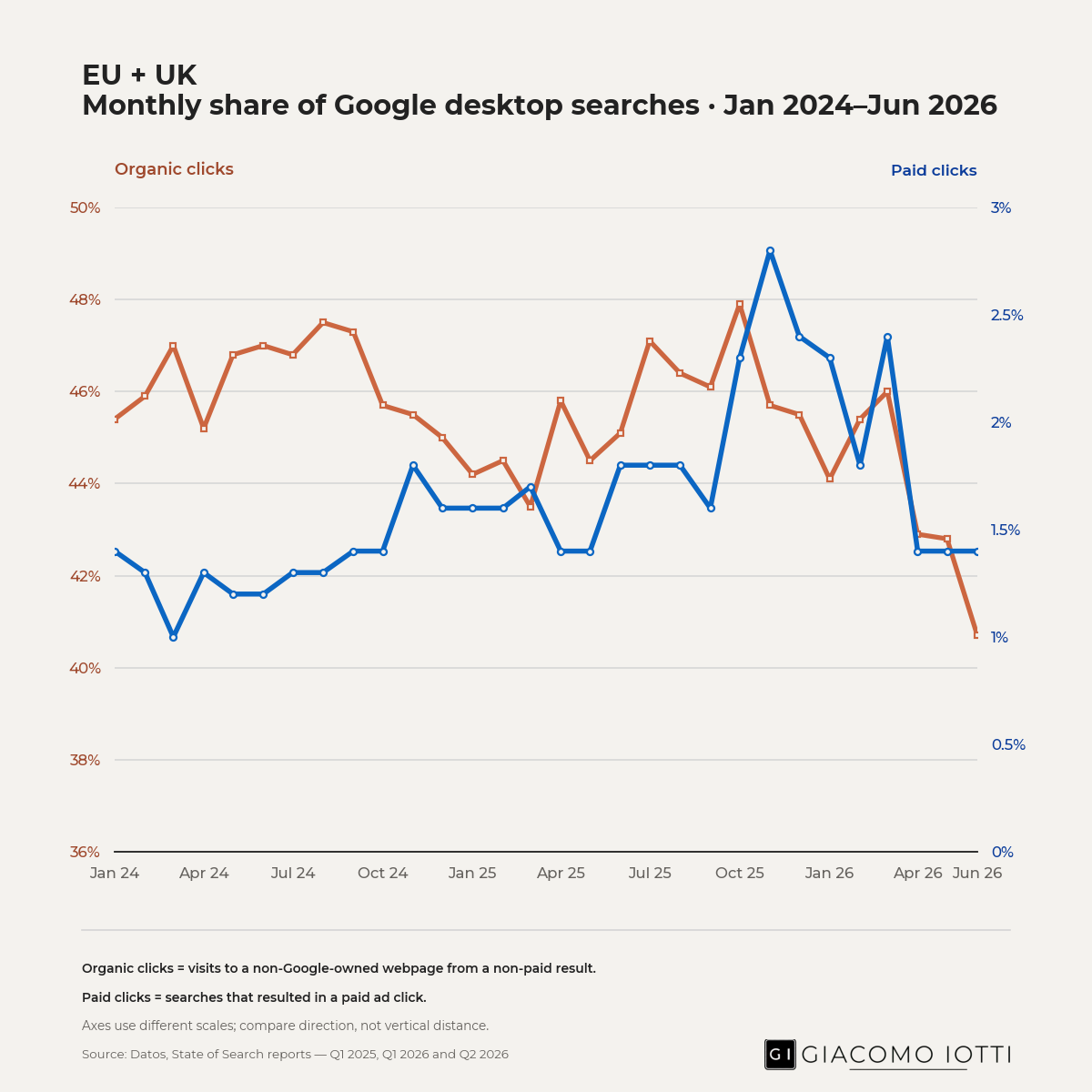
Fewer organic clicks, more paid clicks.


With the zero-click trend growing, it's only logical that Google (and others) push their paid products.


You're losing organic clicks left and right.
Do you want to get them back? just pay 😅


And this will be true on ChatGPT as well.


Source: Datos, A Semrush Company
Chart courtesy of Codex


...more
Line chart with orange squares and blue circles showing EU+UK vs US desktop paid-click shares.
Open on LinkedIn
Expand on page
Portrait of Giacomo Iotti with short dark hair and brown eyes, wearing a dark turtleneck and a dark checkered blazer against a dark background.

When people discuss zero-click search, they often miss one key detail:


Desktop and mobile behave very differently.


Last week, I showed that zero-click searches on Google have declined on desktop. The share of zero-click was lower in Q1 2026 than in 2024.
For the first time in years, the trend seems to have inverted.


But mobile did the opposite.


And because mobile accounts for most Google searches, total zero-click searches still increased in 2026.


The long-term trend continues:
45% of Google searches ended with no clicks in 2016, in the US.
That jumped to 61% in 2024 and 68% in 2026!


But the desktop reversal still deserves marketers’ attention.
It suggests Google search is increasingly two different behaviours.


On desktop, people click through more. They're more willing to research, compare, open tabs, etc
It makes sense.
Desktop is where we handle more complex searches.


Mobile is obviously different.
We're on the go and we want quick answers.
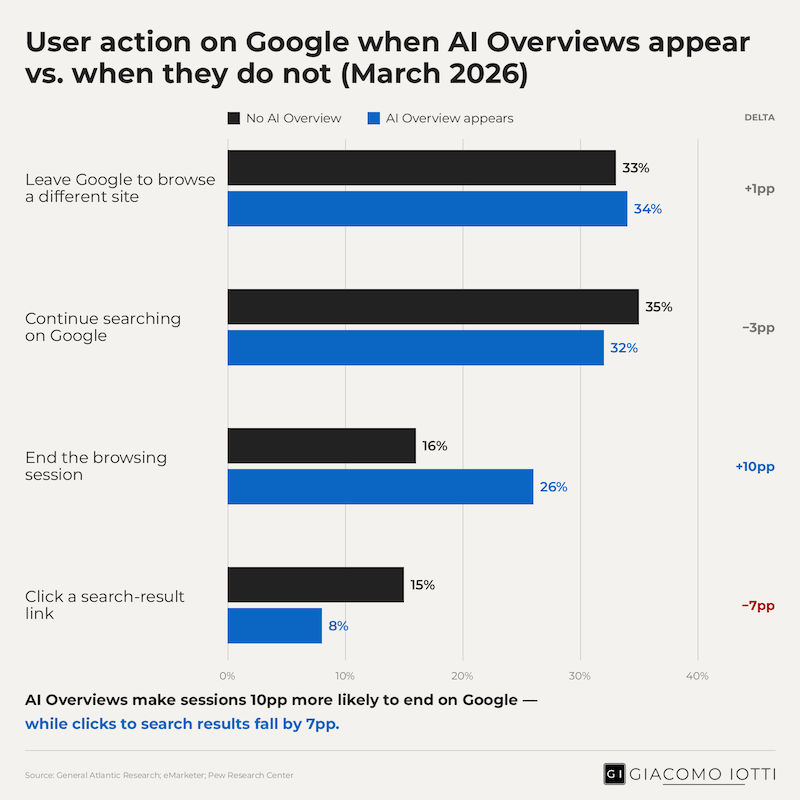
Above-the-fold AI Overviews discourage scrolling and clicks even further.


So, our content strategy should not treat "search" as a single user journey.


📱 Mobile:
Quick answers, definitions, fast comparisons.
💻 Desktop
Deeper analysis, original research, technical content.


Nothing revolutionary.


Marketing in the age AI is just "common sense marketing", where all the best practices from the 2000s of even earlier, are more valid than ever.


But it's always worth repeating,
after a decade of "nerdification" of marketing.


Source: SparkToro, Rand Fishkin
Charts courtesy of Codex


...more
Open on LinkedIn
Expand on page
Portrait of Giacomo Iotti with short dark hair and brown eyes, wearing a dark turtleneck and a dark checkered blazer against a dark background.

Until yesterday, I paid CHF 450/year for a Financial Times subscription.


Then I discovered Revolut Metal.


Now I pay CHF 200/year to Revolut and get the exact same Financial Times subscription included. Less than half the price!


But it doesn’t stop there.


Revolut Metal also includes:
• Perplexity Pro, normally CHF 20/month
• MasterClass, minimum CHF 120/year
• Even Tinder! which can cost over CHF 50/month
• & much more


I understand partnership economics in travel or retail.


Merchants typically share discount codes with partners.
Customers buy more, the basket size goes up, and the higher volume may compensate for the lower margin.


Plus, the merchant acquires a user who may not have come otherwise.
Everyone wins.


But with online subscriptions, I struggle to see the same logic.
There is no larger basket.
And very limited upsell.


In my case, the partnership replaced a full-price subscriber.
No upsell.
No user acquisition.


I stopped paying the Financial Times directly and now access it through Revolut.
In theory, I could be upsold and upgrade to the more expensive FT Premium.
But as far as I understand, not inside the Revolut bundle.
I’d need to give up the entire benefit.
Which I obviously won’t do.


So who is subsidising whom here?


Is Revolut paying a heavily discounted wholesale rate?
Are partners treating this as cheap acquisition?
Not in my case, for sure.


Are they betting that most users never activate the benefits?
Probably.


Revolut gets great marketing for its Metal subscription and partners never deliver the service anyway.


But if other users behave like me, the partner replaces direct revenue with a heavily discounted bundle.


Anyone from Revolut or the Financial Times who can explain how this works?
I’m genuinely curious!


Maybe Linas Beliūnas?
I know you understand Revolut very well.


...more
Metal tab selected; 'Subscriptions included' list with app icons and two plan columns.
Open on LinkedIn
Expand on page
Portrait of Giacomo Iotti with short dark hair and brown eyes, wearing a dark turtleneck and a dark checkered blazer against a dark background.

Zero-click searches are declining.


March 2026 saw the lowest share of Google desktop zero-click searches in the last two years, according to Datos, A Semrush Company and Rand Fishkin.


It doesn't mean the trend is completely reversing (still 1 in 5 searches end with zero clicks), but it's a signal.


After the messy early days of AI Overviews, Google is now trying to solve an almost impossible problem:


make AI Overviews useful for users,
without damaging its relationship with publishers.


To do so, it made the following changes over the past few months:


- More sources, more prominent.
AI Overviews now surface more links, prominently called-out in separate panels or increasingly in-line within the answer.


- Different query mix.
AI Overviews used to be mostly informational. That is changing.
According to Semrush, between October 2024 and October 2025, queries triggering AI Overviews shifted:
• Commercial: 8% → 18.5%
• Transactional: 2% → 14%
• Navigational: 0.8% → 10%
Those type of searches naturally need a click.


- Difference source mix.
A 2026 study by the Washington University in St. Louis found that almost 30% of cited domains in AIO did not appear on the traditional first page of results. Social, videos and forum discussions now represent a significant share of AIO sources and links, but they rarely rank on the traditional SERP.


- More focus on commerce.
Amazon and eBay climbed the ranking of the most cited sources by LLMs.
Their links naturally drive more clicks.


What does this mean for marketing?
I wish I knew 😅.


But what's clear is that our job is becoming harder.
Now we need to do three things at once:


1. Rank in traditional search.
Very important as AI search still represents a small share of usage.


2. Be selected as a source in AI answers.
Different from number 1.


3. Be present where discussions take place.
LLMs increasingly value what real users have to say about a product or service.


It'll be interesting to see how the search landscape will look like in a year from now.


...more
Line chart of monthly % of US and EU & UK Google desktop no clicks.
Open on LinkedIn
Expand on page
Portrait of Giacomo Iotti with short dark hair and brown eyes, wearing a dark turtleneck and a dark checkered blazer against a dark background.

SpaceX says its total addressable market is around $28.5tn.


That number is already absurd.
For comparison, the US GDP in 2025 was around $31tn.


But the breakdown is even more interesting.


According to the S-1 filings, SpaceX sees three main markets:


1. AI: $26.5tn
2. Connectivity: $1.6tn
3. Space: $370bn


SpaceX’s future will not be about rockets.
It will be about AI. What a surprise!


But I’d be careful about dismissing this as just “AI hype”.


The core IPO story is the production and launch of orbital AI data centres.


And this is not as crazy as it sounds.
Several companies are already working on it, and the main bottleneck seems to be launch cost.


This is where SpaceX comes in.


When Starship enters service (and it’s not an if, it’s just a when) launch costs could drop to as low as $185 per kilo.
That is low enough to make the economics of orbital data centres work.


Data centres in space can be an order of magnitude more efficient and powerful than those on Earth. Plus, unlike on Earth, you can build as many as you want.
The sky is literally the limit.


These data centres could power the next generation of AI models.
For xAI, yes.
But more importantly, for third-party models as well.
Anthropic is already renting SpaceX’s Earth-based data centres for $15bn a year.


This is not a speculative market.
It already exists.


And if you pair extreme computing power with Tesla’s autonomous driving and Optimus robots, you start to understand the full scope of Elon’s ambitions.


Another extremely interesting segment is Starlink Mobile and its potential enterprise applications.


Think about what high-speed connectivity in the middle of the Pacific Ocean could enable: floating data centres, underwater factories, military applications, and god knows what else.


Starlink Mobile’s consumer applications are also massive.


The S-1 filings estimate that 5.5 billion people will have a satellite mobile data subscription in the near future.


That would not surprise me.
I’m sick and tired of scummy mobile plan conditions and high prices, only to be left with no connection when I need it most.


Starlink will make mobile internet truly universal.
For anyone, anywhere, at a fair price. And I can't wait!


Forget about Mars and asteroids.
The opportunities I mentioned are already enough to justify a huge potential market.


In fact, the Financial Times estimates that SpaceX’s target valuation is justified if the company can capture just a 3% slice of the TAM mentioned above.


Well, right now, it is close to 100% of it.
We’ll see what competitors do!


Sources: SpaceX S-1 filings, Financial Times, The Economist
Infographic courtesy of ChatGPT.


This is the second instalment in a SpaceX IPO mini series.
I published the first post in the series yesterday.
Tomorrow you'll find the third and last one, focused on the most speculative bets.


...more
Donut chart shows Total Addressable Market of $28.5tn with 80% red share.
Open on LinkedIn
Expand on page
Portrait of Giacomo Iotti with short dark hair and brown eyes, wearing a dark turtleneck and a dark checkered blazer against a dark background.

As always, the Swiss train bringing me to Italy was fairly on time.
It arrived in Milan with a 15-minute delay. I had to run a bit to catch my next train, but that was no problem.


The next Italian train left right on the minute. It arrived at my destination 5 minutes early.


Enough time for me to jump back on the train to grab the suitcase I had left in the luggage rack 😂.


Unfortunately, not enough time to jump back off with it 😅.
So I had to stay on and get off at the next station.


20 minutes later, I caught another train back. This one was also perfectly on time.


On the way back to Switzerland, I was warned about a large strike causing massive disruptions to buses and trains.


My bus to the train station was perfectly on time.
My train to Milan left with a 5-minute delay and arrived right on the minute.


Turns out, the strike was actually limited to a few selected minor routes.
But of course, it was enough for people to claim that “in Italy, nothing works.”


A lot of negative things are said about Italy. Many of them are false or misinformed.


In the picture: the new shiny EuroCity Swiss train from Zurich to Milan.


...more
Open on LinkedIn
Expand on page